Irish Coffee…hmmm!
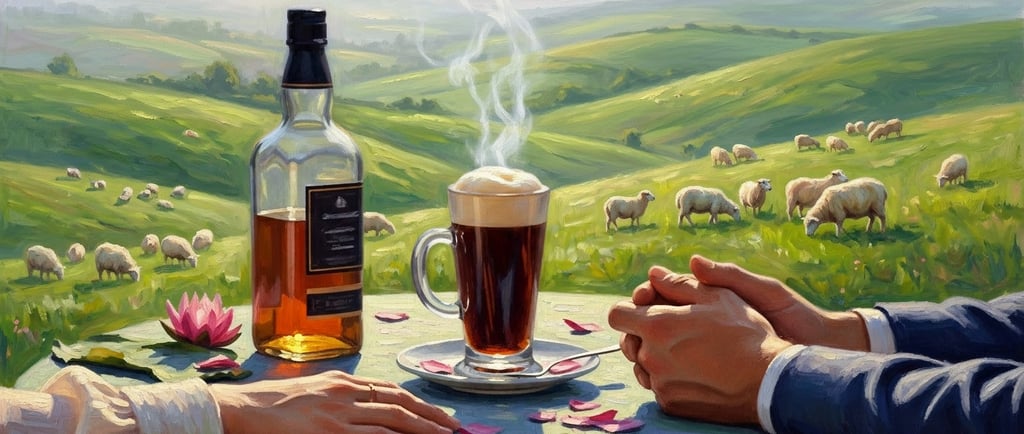
As St. Patrick’s Day approaches, your mind probably goes straight to a pint of stout—but there is another legendary Irish brew that deserves a seat at the table. In "Irish Coffee…hmmm!", we dive into the spirited history of Ireland’s most famous caffeinated export. From the bustling coffee houses of 1660s Dublin to the rainy 1943 night at a Limerick airport where Chef Joe Sheridan first stirred whiskey into a traveler's cup, this post explores how a simple comfort drink became a global phenomenon. Whether you’re curious about the "dangerous" history of coffee bans or want to master the art of the perfect cream float, this story is the perfect companion for your March 17th celebrations.
Maggie MacDougal
3/1/20262 min read
What’s Inside:
A Sip of History: How coffee houses thrived across Ireland despite royal opposition.
The Original Recipe: The specific technique of pouring cream over a spoon to get that iconic layer.
The Global Tour: From Jamaican Rum to Mexican Tequila—how the world puts its own spin on the Irish classic.
Irish Coffee…hmmm!
As we await to celebrate March 17th, St. Patrick’s Day, we must give a nod to another of Ireland's notable drinks – Irish Coffee. Before we discuss the particulars of what makes up this famous beverage, let’s first take a look at the history of coffee and Irish coffee throughout its introduction to Ireland.
The History of Coffee in Ireland
Coffee was first introduced to Ireland in the mid-17th century. The first coffee house was opened by Lionell Newman in Dublin, it is thought, around 1664. Sometime later in this century, a major coffee trading spot was opened on Coffee House Lane in Waterford in the 1690s. By 1698, coffee houses were well established and thriving in Cork, Limerick, Kilkenny, Clonmel, Wexford, and Galway [1].
Throughout the 18th century, Dublin saw more coffee houses appear—establishments that offered intellectual conversation, book auctions, and social gatherings. Before this, in 1675, King Charles II attempted to ban coffee across the three British Isles, including Ireland, fearing the “dangerous effects” of the beverage on radical thinkers. In the 20th century, the public house, or pub, dominated social life, where coffee was also served.
The Creation of Irish Coffee
The 20th century also saw the creation of what we now call “Irish Coffee.” In 1943, at an airport near Limerick, a chef named Joe Sheridan created a drink to comfort passengers. Joe Sheridan mixed hot coffee, Irish whiskey, brown sugar, and cream into the drink we enjoy today.
The Traditional Method
Mixing: Irish whiskey and a teaspoon of sugar are poured over black coffee and stirred until fully dissolved [2].
The Float: Thick cream is poured over the back of a spoon and gradually raised a little until the entire layer is floated [2].
The coffee then became popular worldwide in the 1950s when travel writer Stanton Delaplane brought the recipe to the Buena Vista Café in San Francisco in 1952.
Modern Variations
Today, variations of this popular beverage are named after Irish coffee.
For example:
Jamaican Coffee: Made with rum.
Highland (Gaelic) Coffee: Includes Scotch whisky.
Russian Coffee: Includes vodka.
Mexican Coffee: Includes tequila [2].
So while you celebrate this coming March 17th, why not consider this famous beverage as your drink of choice to honor Saint Patrick? You will not be disappointed and may find yourself ordering this hot beverage after an evening of dining out, making it at home to comfort yourself after a long day, or even to warm up after a snowfall. Whatever your preference, you will surely enjoy this drink—in moderation, of course—as an experience of a little taste of Irish culture.
Happy St. Patrick’s Day!
Maggie
Sources:
CoffeeBI | Coffee Business Intelligence https://coffeebi.com
Wikipedia